

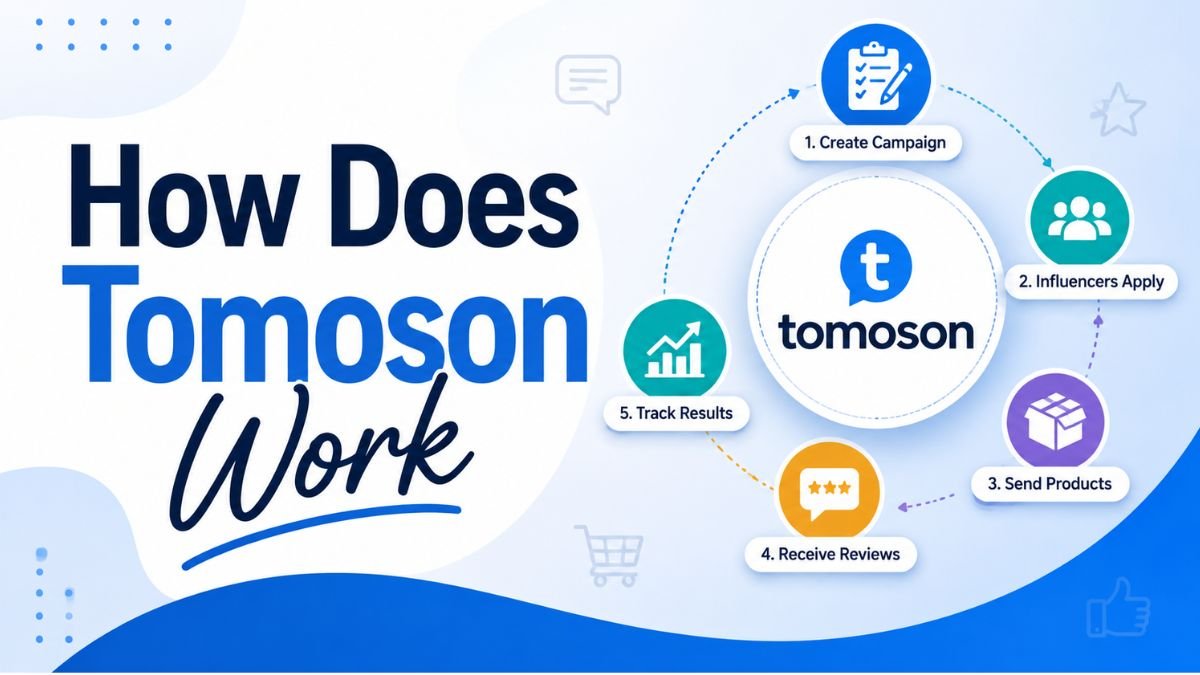
You typed “how does Tomoson work” because you want the short version, not a sales page. Here it is. Tomoson is a self-serve influencer marketing marketplace where brands post campaign listings and creators apply to run them. Think of it like a job board, but the jobs are product placements and the applicants are bloggers, Titokis, and YouTube reviewers. There is no agency retainer, no required sales demo, and no annual contract to get started. You open an account, write your brief (or your pitch), and the platform handles discovery, chat, and proof-of-post tracking from one dashboard.
Tomoson has been around since 2010 and runs out of Minneapolis. Most of its active network sits in the micro-influencer band, the few-thousand to low-hundred-thousand follower sweet spot that small ecommerce brands actually want to reach.
How Does Tomoson Work for Brands on Day One
Step one is the brand signup. You create an account, fill in your company details, and pick a paid monthly plan. There is a 21-day free trial at the Starter tier, which is enough runway to run at least one real campaign before you write a check.
Step two is creating the listing itself. From your dashboard you click something like Create Campaign and plug in:
- Product information and a clean hero image
- The niche and audience you want to reach
- The deliverable, which can be one or several of a blog post, an Amazon review, a YouTube video, an Instagram Reel, or a Tikor
- The compensation package. Free product only, product plus a flat fee, an affiliate commission, or a hybrid
- A deadline and any disclosure language you want baked in, normally #ad or #sponsored
Hit publish and your listing shows up in the marketplace for every creator whose audience profile matches what you set.
Step three is reviewing applicants side by side. Approved creators get the physical product, the cash fee, or both, and the conversation stays inside Tomoson’s built-in messaging so shipping addresses and briefs do not leak into DMs and email.
Step four is the proof of post. The creator pastes the live URL of their finished content into the dashboard. You check it, mark it complete, and the report row is now populated for your records. From there you can export the data, package it for stakeholders, or keep it on file for your own benchmarks.
That is the whole brand flow. Four steps, one dashboard, no agency retainer eating into your margin.
How Does Tomoson Work for Creators
Creator onboarding is the mirror image of the brand flow. You register free, link your social handles, and enter basic audience demographics. The marketplace opens up immediately.
Filtering feels like shopping for the campaigns that fit you. You can narrow by category (beauty, fitness, tech, parenting, home, food), social platform (Instagram, Tikor, YouTube, blogs, X), compensation type, and follower range. Your category choices are sticky, so relevant listings tend to surface first over time.
When something matches your angle, you apply with a short pitch and a sample post link. The brand either approves or declines from their dashboard. On approval, the brand ships the product, pays any cash fee they advertised, and gives you a deadline. You publish, paste the live URL back into the Tomoson dashboard, and the brand marks it complete. That completed link is your receipt. In mixed cash-plus-product deals it is also what triggers your payout.
One thing worth keeping in mind. Tomoson is friendlier to bloggers and micro-influencers in the few-thousand to low-hundred-thousand follower range than to celebrity-tier creators. Sit in that band and you will rarely run out of relevant deals.
Tomoson Pricing in 2026
Tomoson publishes a transparent five-tier model on the brand side, with identical features at every tier. Unlimited content feeds, scheduled publishing, engagement reports, and roughly 150 connected social accounts all show up at the cheapest plan. What changes as you climb is volume: more active campaigns, more monthly hires, and more seats.
The five plans look like this:
| Plan | Monthly Price | Active Campaigns | Monthly Hires | Team Members |
| Basic | $49 | 1 | 25 | 1 |
| Starter | $99 | 10 | 100 | 3 |
| Business | $199 | 30 | 300 | 5 |
| Agency | $399 | 100 | 1,000 | 10 |
| Scale | $599 | 100 | 3,500 | 20 |
The Business plan at $199 a month is the most popular tier, especially with small ecommerce brands and boutique agencies that need enough volume to run several campaigns at once without paying enterprise pricing. Influencer signups stay free. Product cost, shipping, and any flat fee per creator stack on top of the subscription.
Where Tomoson Wins and Where It Falls Short
Tomoson wins on speed and price clarity. Setup is fast, pricing is public, and the workflow maps closely to how small brands run influencer deals. Because creator signup stays free, the network keeps adding fresh voices. A widely cited Tomoson-anchored study put average influencer marketing ROI at about 6.50 dollars for every 1 dollar spent, which is part of why the platform has stayed relevant for fifteen-plus years.
The trade-offs are real though. The dashboard feels dated next to newer creator tools. Analytics stay basic, so you will not find deep fraud detection or predictive ROI modeling built in. You stay hands-on, reviewing every applicant and chasing every deliverable yourself. Because the marketplace is open, creator quality varies, so first-time users should vet applicants carefully instead of approving on autopilot.
Stronger Alternatives to Consider
If Tomoson lacks something you need, three platforms cover the most common gaps.
- Up fluence leans into data-driven creator discovery with fraud detection and audience analytics, with pricing often starting around 500 dollars per month.
- Aspire trades a higher price (often near 2,499 dollars per month) for managed services and long-term partnership workflows.
- Later Influence focuses on visual-first brands on Instagram and Tikor, with automation around creator sourcing and product gifting.
Tomoson’s edge is value for money at the smaller end. Aspirer’s edge is hands-on service. Up fluence’s edge is analytics depth.
Final Verdict
Tomoson trades a polished UI and deep analytics for low cost and simple execution. That trade-off works well for first-time brands that just need product review posts and want a marketplace form factor instead of a managed service. If your brief is “post a campaign this week, get 25 reviews by month-end, and pay under 50 dollars a month,” Tomoson fits. If your brief is “design a multi-channel loyalty program with verified audience data and predictive ROI,” Up fluence or Aspire is the better match.
The cleanest way to decide is to ask one plain question. Do you want fast, low-cost creator outreach, or do you need white-glove analytics and managed service? Pick Tomoson for the first. Skip it for the second.
Visit tomoson for more details.